 Eigenlayer
Eigenlayer lets an authorized reward claimer choose the payout recipient
Updated on
Eigenlayer reward claims let the authorized claimer choose the address receiving the payout. The earner holds the reward entitlement, and the recipient receives the tokens. Without a designated claimer, the earner claims directly. Appointing a separate address gives it control over where unclaimed rewards go. Replacing that address changes who can direct later claims, including rewards already earned, while completed transfers remain outside the scope of the setting.
Reward entitlement stays with the same earner
Every claiming arrangement draws on rewards assigned to the earner, whether that account claims directly or appoints another address. The RewardsCoordinator contract stores the appointment in claimerFor, a mapping from each earner to its designated claimer. A payout recipient identifies the destination for the tokens in the claim. The caller supplies that address through the recipient argument of processClaim. Changing the destination therefore does not require changing the earner or rewriting the reward allocation.
The designated claimer can pay itself or another address; processClaim requires no separate approval from the recipient.
Self-claiming and delegated claiming have different recovery dependencies
Self-claiming keeps claim authority with the earner account; a separate claimer introduces another address whose availability and controls matter. A contract can act as the claimer if it has working logic to call the RewardsCoordinator. The protocol recognizes the contract as the caller, while the contract's own rules determine who can trigger that call.
| Claiming arrangement | Who directs the payout | Dependency if claim access fails |
|---|---|---|
| Self-claiming with no designated address | The earner account | Access to the earner account |
| A separate signing address as claimer | The designated signing address | The earner can replace or clear the appointment |
| A contract capable of submitting claims | The contract through its claim logic | Working contract controls, or replacement by the earner |
A separate signer can submit reward transactions without holding the earner's signing key. That arrangement leaves access to unpaid rewards with the signer, because it can select their destination. A contract may constrain recipients through its own implementation, but the basic claimer appointment adds no recipient restriction. Merely naming a contract does not give it suitable claim logic or an automatic recovery feature.
Who can replace the reward claimer?
The earner can replace its own claimer, and eligible operator or service accounts also support an authorized management route.
The single-argument setClaimerFor function updates the caller's own claimer setting.
A wallet acting as the earner can use this form to assign a new address or clear an existing appointment. A contract earner needs its own supported mechanism for making that call.
The outgoing claimer does not need to approve the change, and the new address needs no separate acceptance transaction.
The two-argument setClaimerFor form names both the earner and its replacement claimer. It checks authorization through PermissionController and restricts this route to registered operators or service accounts with at least one operator set. An admin can call this integrated setter. An appointee needs permission for the specific contract and function. Ordinary stakers do not gain this management route simply by setting a claimer.
An admin appointment only takes effect after the proposed admin accepts it. Administrative access does not automatically make that address the reward claimer; the claim call still checks claimerFor.
What changes when a replacement takes effect?
A successful claimer-setting transaction changes authorization for claims executing after that update. The setter writes the new address directly; it does not apply the reward root's activation delay. The contract checks the stored claimer when each claim executes, rather than preserving authority when someone prepares a transaction. A claim from the outgoing address can therefore fail if the change executes first. If its payout executes before the change, replacing the claimer cannot reverse the transfer.
Clearing the setting with the zero address restores self-claiming. It does not disable claiming or erase the earner's entitlement.
Cumulative earnings survive a change of claimer
The contract records cumulative claimed rewards by earner and token. For each token in a valid claim, the payment equals its proven cumulative earnings minus the amount already claimed. The contract advances that claimed total when it pays. A replacement therefore cannot claim the same accumulated amount again merely by using a different address. Its access covers the outstanding rewards the earner's record supports.
The appointment also reaches earnings from before the change if they remain unpaid. The reward proof establishes the earner and token entitlement; it does not bind the claim to the earlier claimer. Changing the appointment does not itself invalidate an otherwise valid proof. A claim still fails for a token whose proven cumulative earnings do not exceed its already claimed total.
Claim readiness remains separate from address control
A correctly authorized address still needs a usable distribution root and matching proofs to collect rewards. A reward distribution root must reach its activation timestamp before a claim can use it. A disabled root cannot support a successful claim. The proof must establish both the earner's entry and the selected token entries within that distribution. Replacing a claimer does not accelerate these conditions, add earnings to a missing entry, or make an invalid proof acceptable.
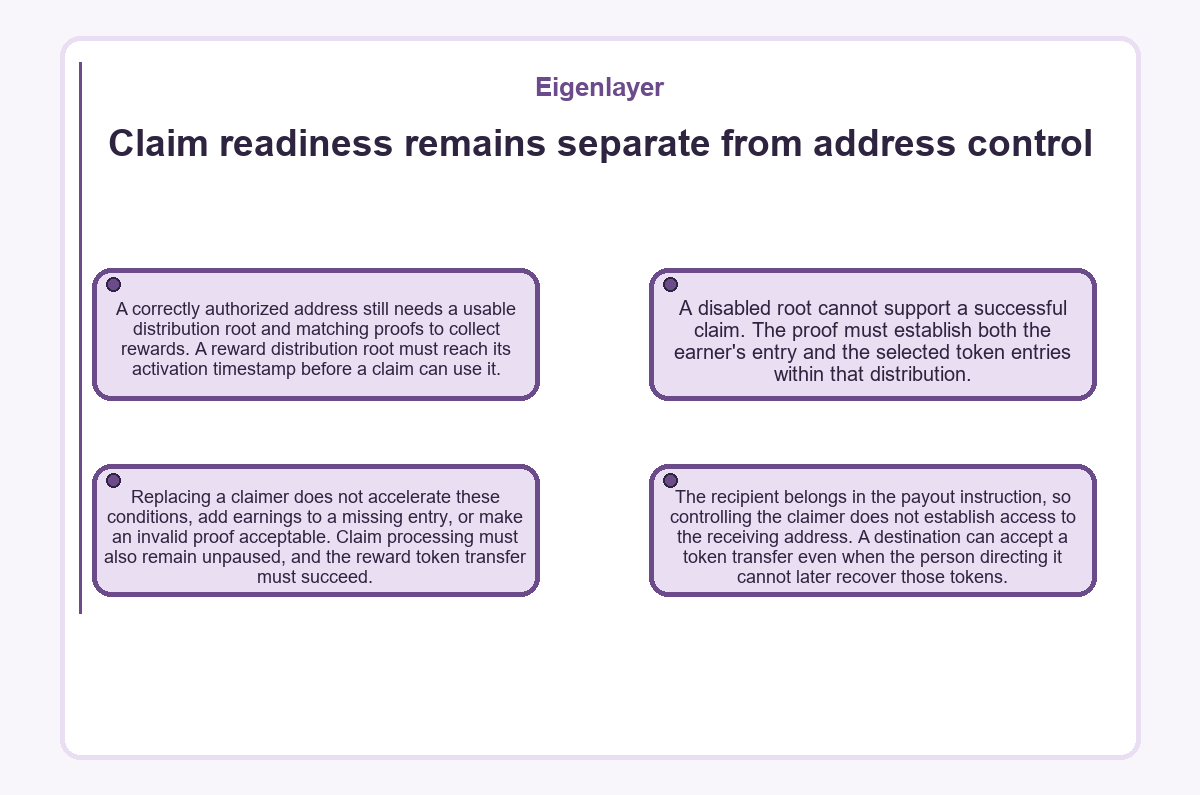
Claim processing must also remain unpaused, and the reward token transfer must succeed. The recipient belongs in the payout instruction, so controlling the claimer does not establish access to the receiving address. A destination can accept a token transfer even when the person directing it cannot later recover those tokens.
Reward routing leaves stake delegation and slashing obligations unchanged
Separating the claimer from the recipient supports different tasks: one address handles claim submission, while another holds the resulting tokens. That can keep routine reward transactions away from the earner's signing key, provided the separate address has actual claim authority. The setClaimerFor operation changes the reward appointment without moving restaked principal or assigning stake to a different operator. It also leaves the applicable slashing obligations intact.
Recipient choice can change between claims without replacing the claimer. Restricting destinations requires controls in the claiming account or contract; the appointment itself gives the authorized caller discretion. If the claimer also controls the earner account or has permission to change its claimer, replacing only the appointment leaves that management authority available.
Eigenlayer: reader questions
Can I send different reward tokens to different recipients in one claim?
A single processClaim call uses one recipient for all token leaves it includes. Different destinations require calls with their own recipient arguments for the relevant tokens. The protocol allows selecting which earned token leaves to claim, so a claim need not include every available reward token.
Is an ERC-20 allowance enough to appoint a reward claimer?
An ERC-20 allowance does not appoint a reward claimer. An allowance authorizes a spender to transfer tokens under that token contract's rules. Reward-claim authority comes from the earner's claimerFor setting in RewardsCoordinator. Approving a spender and authorizing a reward claimer change different permissions, even if both involve the same address.
Does one failed claim invalidate a batch reward transaction?
A reverting claim causes the whole processClaims call to revert. The same caller must satisfy the claimer requirement for every earner in the batch, and each claim must pass its other checks. Earlier payouts within that reverted call do not survive. Large batches can also exceed transaction gas limits.
What reward information reveals the payout destination?
The RewardsClaimed event records the recipient, earner, claimer, token, and claimed amount, so using a separate payout address leaves an on-chain record connecting the reward entitlement to the address submitting the claim and the destination receiving its tokens.
How much of one token's reward balance can I choose to claim?
A claim pays the difference between the selected leaf's proven cumulative earnings and the earner's previously claimed total. processClaim has no argument for an arbitrary smaller payout amount. Editing the earnings in a proven leaf invalidates its proof; selecting token leaves chooses which tokens to include.